Shenzhou VI
Introduction
Shenzhou VI is the second human spaceflight mission of the Chinese Shenzhou program. Following the success of Shenzhou V, which marked China's first crewed space mission, Shenzhou VI continued China's advancement in human space exploration. It was launched on October 12, 2005, aboard a Long March 2F rocket from the Jiuquan Satellite Launch Center.
Mission Objectives
The primary objective of Shenzhou VI was to further test and validate the systems required for extended human spaceflight missions. The mission aimed at verifying the reliability and performance of the spacecraft's life support, navigation, and control systems over a prolonged period. Additionally, it was significant for assessing the crew's ability to live and work in space for a more extended duration compared to Shenzhou V.
Crew and Spacecraft
The Shenzhou VI mission was crewed by two astronauts, Fei Junlong and Nie Haisheng. The spacecraft has three modules: a forward orbital module, a reentry module, and an aft service module. The forward orbital module remained in orbit for further experimentation after the mission.
Launch and Orbit
The mission began with the launch from the Jiuquan Satellite Launch Center at 09:00 local time on October 12, 2005. The Long March 2F rocket successfully placed the Shenzhou VI spacecraft into low Earth orbit. The spacecraft orbited Earth at an altitude between 200 and 350 kilometers, with an orbital period of approximately 90 minutes.
Mission Duration and Activities
Shenzhou VI spent nearly five days in space, conducting various experiments and gaining experience in long-duration spaceflights. The mission involved scientific research, including biological experiments and studies on the effects of microgravity on physical and physiological processes. The astronauts performed tasks within the spacecraft, such as equipment checks, maintenance, and data collection.
Landing and Aftermath
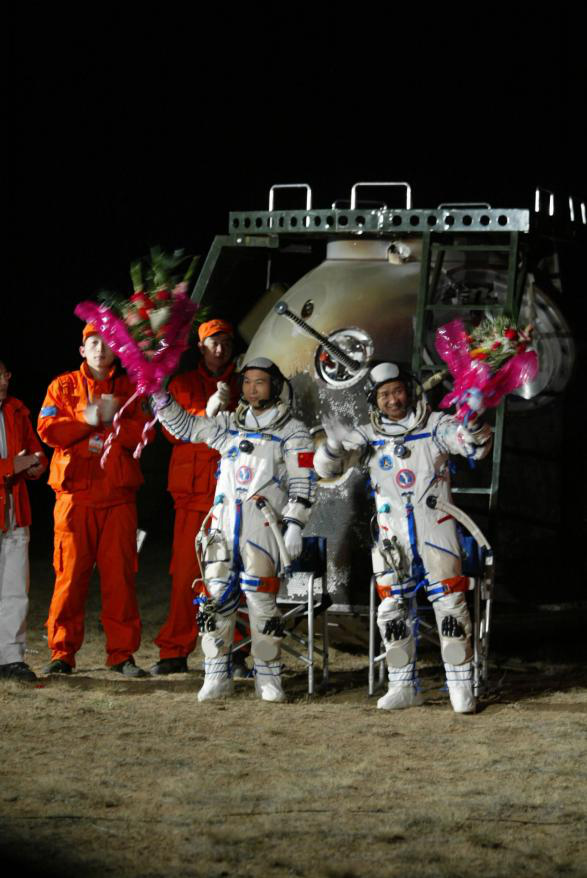
The mission concluded successfully with the safe landing of the Shenzhou VI reentry module in the Inner Mongolia autonomous region on October 17, 2005. The mission's success was a significant milestone for China's space exploration efforts, demonstrating their capability for more complex human spaceflight missions. Shenzhou VI also laid the groundwork for subsequent missions and contributed to the development of China's Tiangong space station program.
Impact and Legacy
Shenzhou VI's success reaffirmed China's status as a prominent player in space exploration. The mission inspired a growing interest in space technology and science among the Chinese public, particularly the younger generation.
The mission also had a broader impact on the international space community, highlighting China's increasing capabilities and ambitions in space exploration. The experience and knowledge gained from Shenzhou VI have been instrumental in advancing China's human spaceflight program, paving the way for more sophisticated missions and the eventual construction of a permanent space station.








